Cats are considerably better at hiding discomfort than dogs. This is part of their survival heritage — prey species and predators alike do not benefit from advertising vulnerability, and cats have retained this discretion even in domestic settings where the predator threat is limited to the vacuum cleaner.
The practical consequence: a cat who is overheating may not show obvious signs until they are already in significant distress. Unlike a dog who pants visibly and seeks shade with readable urgency, a cat may simply become quieter, less interactive, and slightly less interested in food — signs that a busy owner could easily miss for hours.
It doesn’t always have to be ‘hot’ for an animal to develop heatstroke. Being left in a warm or humid environment that is poorly ventilated can cause animals to quickly overheat.
These eleven tips are the summer cat care practices that keep your cat comfortable, safe, and — when it comes to the signs of overheating — visible enough to catch before they become emergencies.
Tip 1: Keep Indoor Temperature Below 80°F (27°C)
The most effective summer cat care intervention is also the simplest: air conditioning. Cats do not tolerate extreme heat any better than humans do, and an indoor temperature above 80°F begins causing genuine discomfort in most cats. Above 90°F, heat stroke becomes a real risk even in otherwise healthy indoor cats.
If your home does not have central air conditioning, prioritize a room air conditioner or window unit in the room where your cat spends most of their time. During heat waves, this is not an optional comfort upgrade — it is health infrastructure.
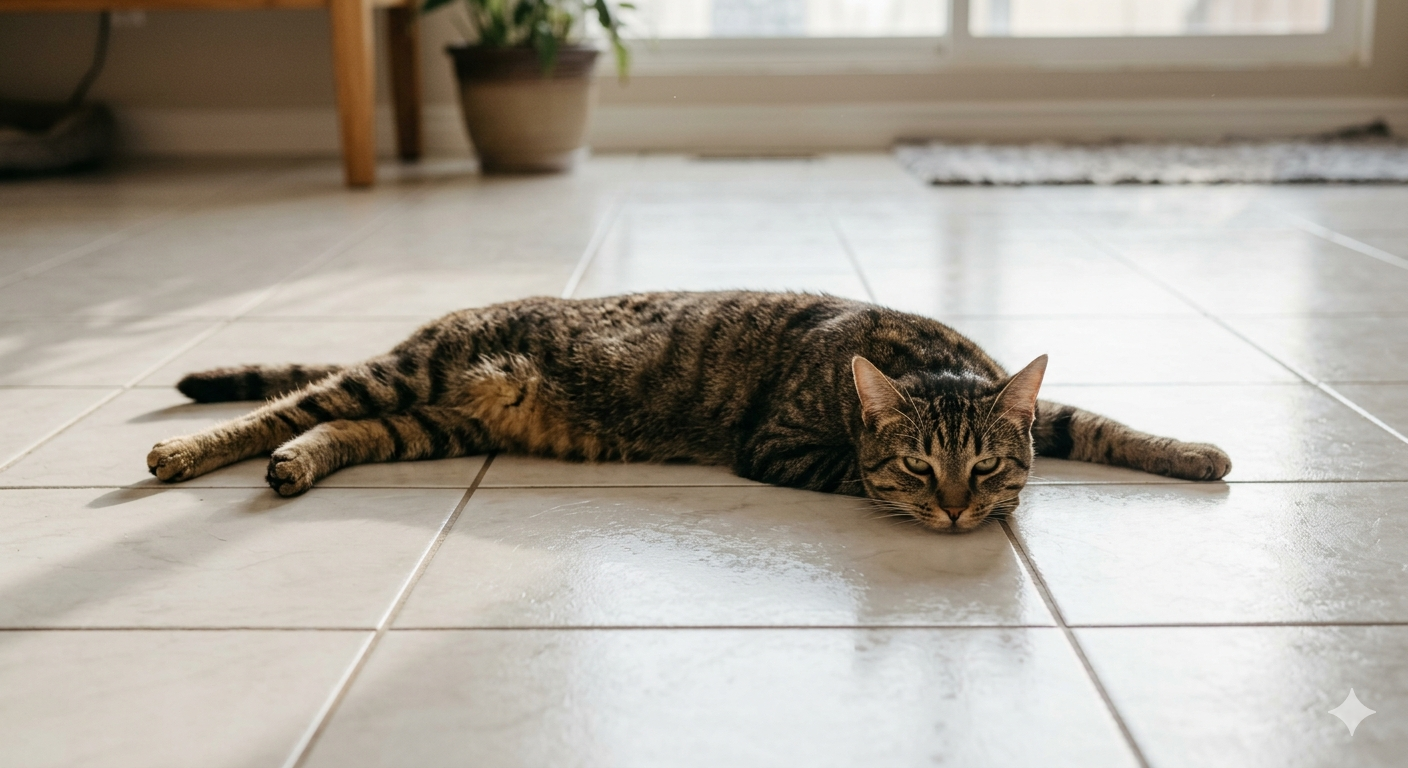
For homes without any air conditioning: fans positioned to create air movement (not blowing directly at the cat, which most cats dislike, but creating circulation in the room), cool tile floors in a bathroom or kitchen as a resting option, and closed blinds to block solar gain through windows all reduce indoor temperature meaningfully.
Tip 2: Create Cool Resting Spots Strategically
Cats self-regulate their temperature by seeking cooler environments — but they can only seek what you have made available to them. In summer, creating deliberately cool resting options throughout the home allows your cat to manage their own comfort effectively.
Options that work:
- A cooling pet mat (contains gel that stays cool without refrigeration) placed in a shaded area
- A small cardboard box with a cool, damp towel inside — cats are drawn to enclosed spaces, and the damp towel provides cooling
- A ceramic tile placed in a cool area of the floor — ceramic holds cool temperature and releases it slowly
- A cleared bathroom or kitchen tile floor area — these surfaces stay measurably cooler than carpet
The cat will find the coolest spot in your home regardless of whether you intended it. The point of creating deliberate cool spots is ensuring those spots are safe, accessible, and optimally cool rather than whatever your cat improvises.
12 Indoor Cat Enrichment Ideas That Actually Work →
Tip 3: Fresh Cool Water at Multiple Locations
Cats in warm weather need more water than in cooler seasons, and they are notoriously inconsistent drinkers even in ideal conditions. Summer requires both increasing the available water and making it as appealing as possible.
Multiple water stations reduce the distance between a hot cat and a drink. Add ice cubes to water bowls in the morning — most cats are more interested in cool water than warm water, and the movement of ice in the bowl provides additional appeal to cats who prefer moving water.
A cat water fountain is one of the most effective summer hydration tools available — the continuous movement both aerates the water and keeps it slightly cooler than still water in a bowl, and it is a format that many cats drink from significantly more readily than static bowls.
Tip 4: Never Leave Your Cat in a Car
According to a recent study, the temperature inside a car increases by an average of 40°F per hour. This means even if it is only 70°F outside, the inside of the car can easily be greater than 110°F.
This applies equally to cats as to dogs. A cat left in a parked car during summer — even briefly, even with windows cracked — is in genuine danger. Cars heat faster than most people expect and cool slower than most people hope. The only safe option is to never leave a cat in a parked car during warm weather.
Tip 5: Know the Signs of Feline Overheating
Cats overheat differently from dogs, and the signs are less immediately obvious. Knowing specifically what to look for prevents the delayed recognition that allows mild overheating to progress to heat stroke.
Early overheating signs in cats:
- Restlessness and inability to settle comfortably
- Grooming excessively — licking fur to wet it for evaporative cooling (this is a real thermoregulation behavior in cats)
- Seeking the coolest available surfaces obsessively
- Reduced appetite and reduced activity
- Rapid breathing
Serious overheating signs:
- Panting (cats do not normally pant — panting in a cat is always a sign of distress)
- Drooling (also uncommon in cats at rest)
- Bright red or pale gums
- Vomiting or lethargy
- Loss of coordination or collapse
If you see panting in your cat, act immediately: Move to the coolest available area. Apply cool (not cold) damp cloths to the paw pads, armpits, and back of the neck. Offer cool water but do not force drinking. Contact your veterinarian — panting in a cat warrants a call regardless of other signs.
Tip 6: Groom More Frequently — But Don’t Shave
Long-haired cats benefit from more frequent brushing in summer to remove the loose undercoat that reduces airflow and traps heat. A well-groomed coat actually provides better thermal regulation than a matted or shedding one — the loose undercoat acts as insulation in both directions, trapping heat in summer and cold in winter.
What not to do: shave your cat. Despite appearing logical (less fur = cooler cat), shaving removes the coat’s thermoregulation function and exposes skin that is not adapted to direct sun exposure, increasing sunburn risk and potentially worsening temperature regulation.
For long-haired breeds during heat waves, a professional groom to remove the heaviest undercoat buildup while maintaining the coat structure is beneficial. Discuss with a groomer experienced with your specific breed.
Tip 7: Provide Frozen Cat Treats
The same principle that makes frozen treats an excellent summer dog intervention applies to cats — cold food and treats lower core temperature from the inside while providing engagement and hydration.
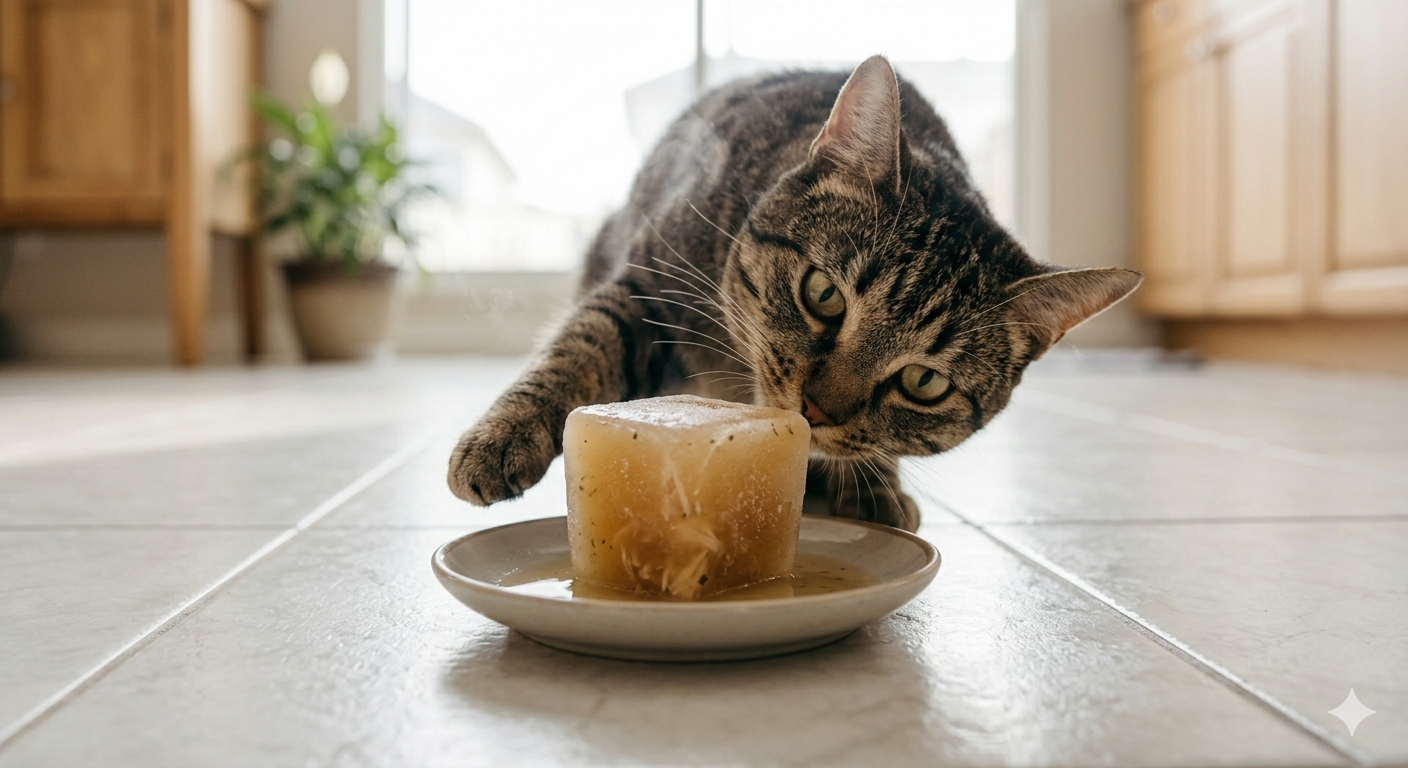
Simple frozen cat treats:
- Ice cubes with a small piece of tuna or chicken frozen inside — the cat licks the cube to extract the treat
- Frozen low-sodium chicken broth ice cubes — a savory hydration treat for cats who do not drink enough water
- Frozen wet food portions — take their regular wet food, divide into ice cube portions, freeze, and serve partially thawed on hot days
Not all cats accept cold treats immediately — introduce frozen offerings gradually and serve them partially thawed if your cat initially shows no interest in the fully frozen version.
Tip 8: Restrict Outdoor Access During Peak Heat Hours
Outdoor and indoor-outdoor cats need to be managed differently in summer than in cooler seasons. The 10 am–4 pm window during heat waves represents the period when outdoor temperatures and surface temperatures (pavement, rock, and dark soil can reach temperatures that burn paw pads) present a genuine risk.
Remember, hot pavements can burn paws — if it’s too hot to hold your hand on, it’s too hot for your pet to walk on.
For indoor-outdoor cats: keep them inside during peak heat hours. Offer enhanced indoor enrichment during this period — puzzle feeders, additional interactive toys, and window perches where they can observe the outdoor world without being in the heat. The transition back to outdoor access in the early evening, when surfaces have cooled, satisfies the outdoor drive without the heat risk.
Tip 9: Create Airflow Without Direct Fan Exposure
Most cats do not enjoy being in the direct airflow of a fan — the sensation is uncomfortable for them, and they will avoid it, defeating the purpose. The effective summer fan strategy is to create airflow through the room rather than directing it at the cat.
Position fans to draw hot air out of windows (facing outward) rather than blowing air in. Create cross-ventilation by opening windows on opposite sides of the home and positioning fans to support the airflow direction. The result is a cooler room that the cat can choose to occupy, rather than a focused airflow they will avoid.
Tip 10: Monitor Outdoor Cats — They Cannot Always Find Their Way to Safety
Outdoor cats who have access to cool, shaded areas of the garden manage summer heat remarkably well — they are self-regulating and will naturally seek the coolest available spot. The risk arises when an outdoor cat gets trapped in an enclosed space — a shed, a garage, a greenhouse, any enclosed structure that heats rapidly in the sun.
Check any enclosed outbuildings before closing them. Be aware of which areas of your garden reach dangerous temperatures during the hottest parts of the day — a south-facing brick wall that is pleasant in spring can radiate heat that makes the surrounding area genuinely dangerous in summer. Ensure your outdoor cat always has access to the main house or another cool, shaded, ventilated space.
Tip 11: Increase Wet Food in Summer
Wet food is approximately 70–80% water. Increasing the proportion of wet food in your cat’s summer diet is one of the most straightforward and most consistently effective hydration interventions available — particularly for cats who are reluctant drinkers from water bowls.
During heat waves, transitioning temporarily to a wet-food-only diet significantly increases daily water intake without requiring any behavioral change from the cat. They simply eat their meals and receive significantly more water than a dry-food diet would provide.
For cats who are on primarily dry food for veterinary reasons, discuss summer hydration strategies with your veterinarian. Adding a small amount of warm water or low-sodium broth to dry food is sometimes a useful middle ground.
ENDING:
Your cat will not tell you they are too hot. They will become quieter, seek the tile floor, drink slightly more water, and groom more carefully — and only a cat owner who knows what to look for will read those signals correctly before they progress to something more serious.
Now you know what to look for. And you have eleven ways to make sure the situation that requires emergency recognition never develops in the first place.
Save this summer cat care guide to Pinterest, share it with every cat owner heading into their first hot summer, and make sure the water bowl is full, cold, and accessible right now. Your cat noticed you sitting down to read this. They want to know if it resulted in treats.