The bathroom sink. The top shelf of the closet, behind the winter coats. The laundry basket full of clean clothes you literally just folded. The box the delivery arrived in three weeks ago that you keep meaning to move. The exact center of the laptop keyboard during a deadline.
If you share your life with a cat, you have found them in all of these places. Possibly simultaneously. And each time, you have had the same thought — why this, specifically? Of all the comfortable, soft, appropriately-sized surfaces available in this home, why the sink?
The answer is not random, and it is not chaos. Every strange, inexplicable, mildly inconvenient sleeping location your cat has chosen has a specific, logical, and genuinely fascinating reason behind it. This is the guide that explains all of them — and transforms the next time you find your cat asleep in the vegetable crisper drawer from mildly exasperating to genuinely impressive.
1. The Enclosed Space Pull — Anything That Fits Is a Box
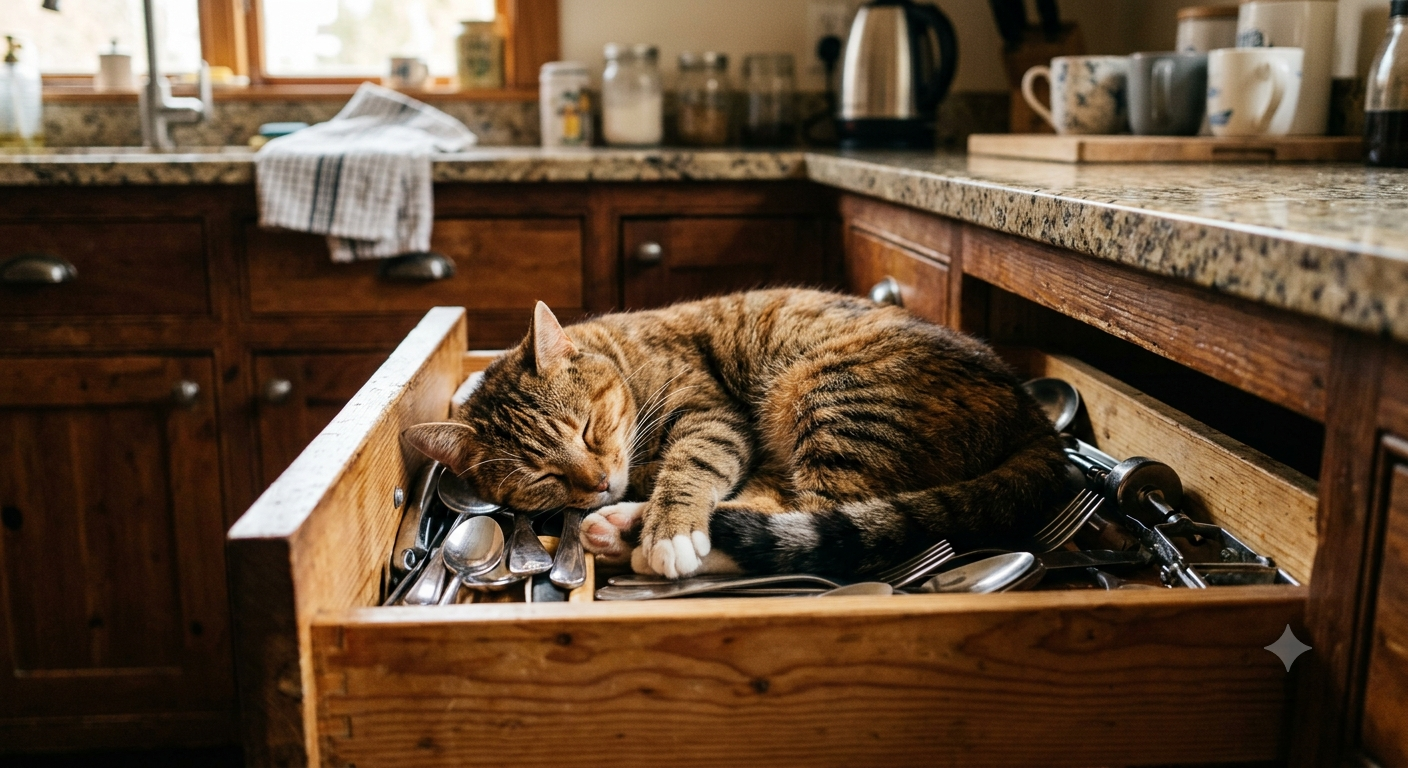
The cardboard box. The kitchen cabinet with the door left open. The closet with a gap. The space under the bed between the dust ruffle and the floor. The bathroom sink. What do all of these have in common?
They are enclosed. They have walls on at least three sides. The cat’s body fits them with some degree of snugness. And that is all the selection criteria that a significant portion of feline nap location evaluation requires.
The enclosed space instinct is ancient and powerful. In the wild, sleeping in a hollow tree, a rocky crevice, or dense undergrowth protects approach on multiple sides — a predator must approach through the opening, which the sleeping cat can monitor without turning their head. The enclosure does not eliminate threats. It reduces their vectors. It converts an infinite threat landscape into a single manageable entrance.
Your domestic cat has the same instinct operating in a home without any genuine threats. The bathroom sink — curved, smooth, slightly cool, fitting the cat’s body with an almost eerie precision — is, from the cat’s behavioral perspective, an excellent rocky crevice. It has walls. It has a single clear entrance. It is elevated. It is perfect. The fact that it is a plumbing fixture in a bathroom is irrelevant to the instinct that chose it.
2. The Laptop Gravity — Why Your Screen Is Always Their Target
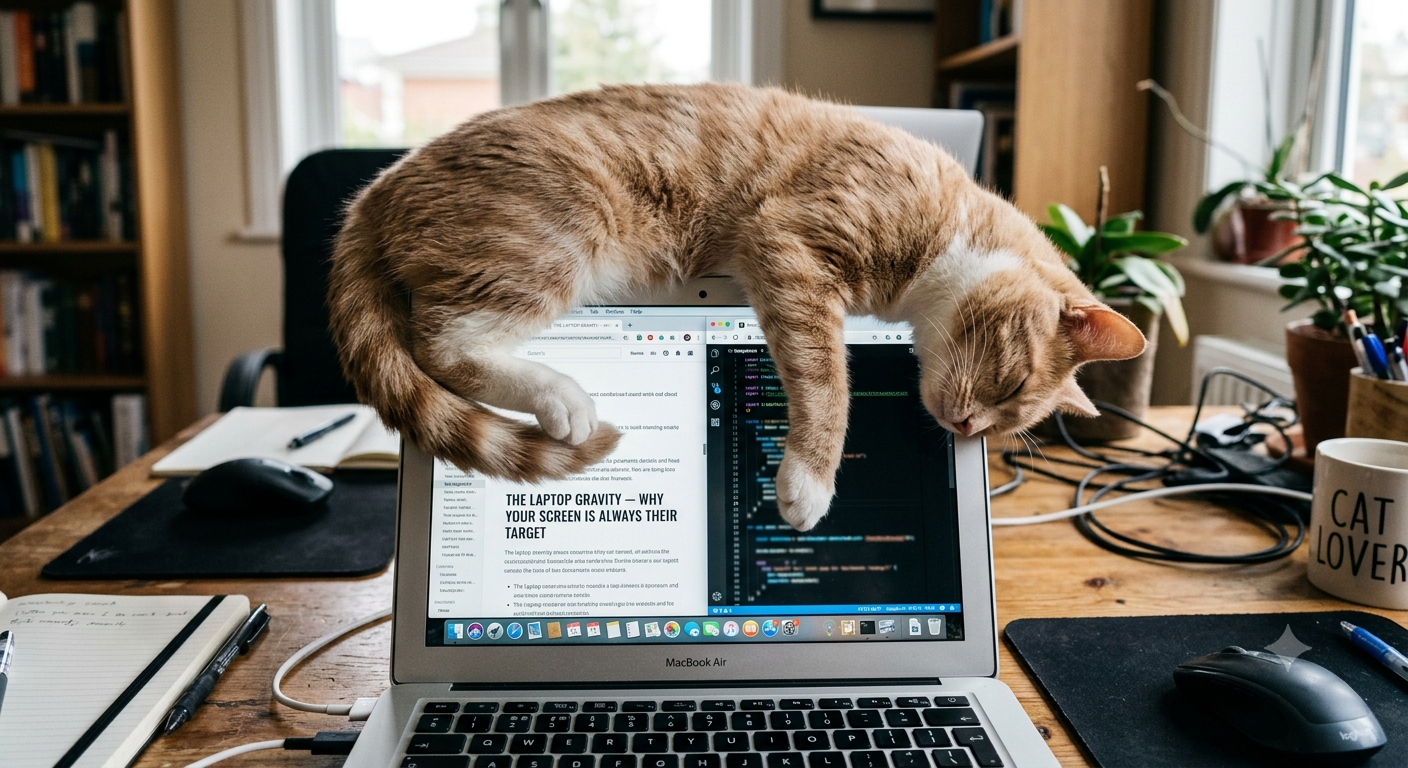
It is warm. This is the beginning of the laptop explanation, and for some cats it is the complete explanation. The underside of a laptop generates significant heat during operation — more heat than almost any other surface in the typical home environment. The cat seeking warmth has located the warmest portable surface available and claimed it with the efficiency that their thermoregulation demands.
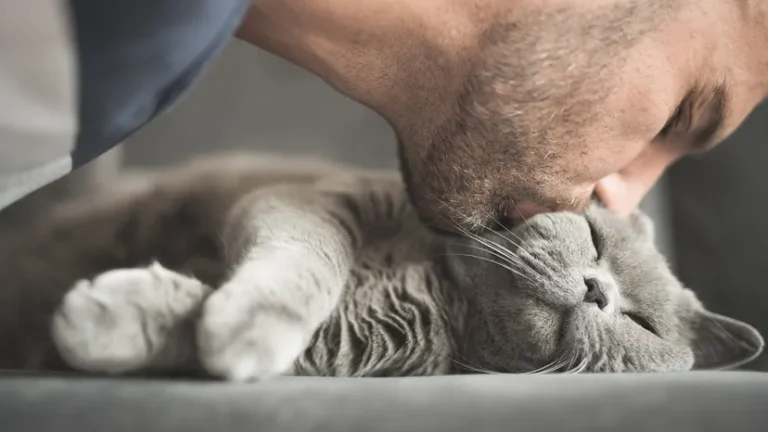
But it is also — and this is the part that is harder to admit — near you. The laptop is where you are. The screen is what has your attention. Petting or cuddling a cat can lower blood pressure, reduce cortisol levels, and trigger the release of oxytocin — the bonding hormone. For cats, snuggling against their owner provides a similar stress-relieving effect.
The cat who sleeps on your laptop is the cat who wants proximity to you while you are occupied with something else. The laptop is between them and your attention. Eliminating the laptop, from the cat’s perspective, eliminates the competition. They are not being disruptive. They are being affectionate in the only way they know how at a moment when the usual proximity channels are blocked.
The correct response is to provide an alternative warm, elevated surface near your workspace — a blanket, a heating pad on the desk corner, a cat bed at desk height. The cat’s need is proximity and warmth. You can satisfy both without sacrificing your keyboard.
3. The Laundry Basket — A Symphony of Scent
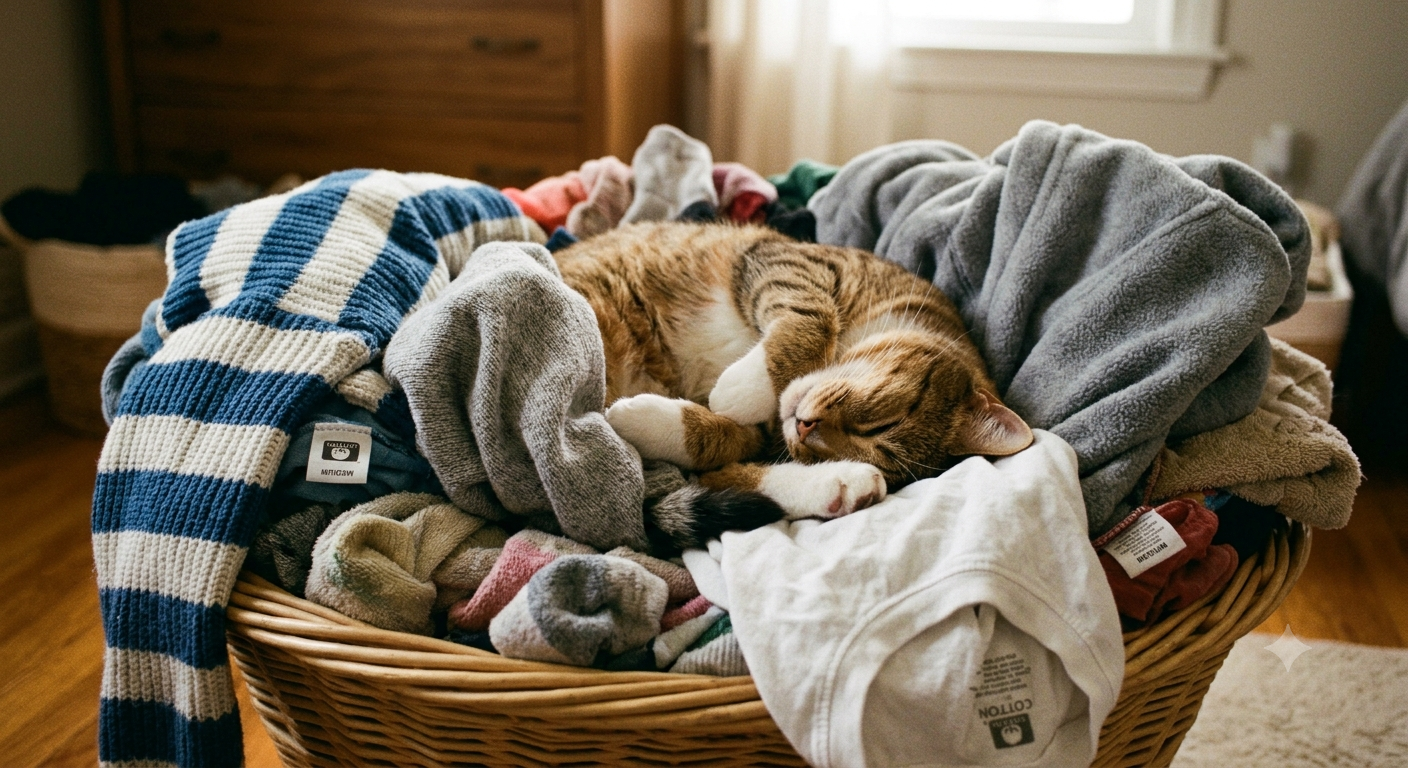
The freshly laundered clothes represent something specific from the cat’s olfactory perspective: the complete and utter absence of your scent.
Your worn clothes — the things you left on the chair or the floor — carry the full complexity of your individual scent signature. Cats find this comforting. The freshly washed laundry in the basket carries none of it. And a cat who has been separated from their person during the laundry process, or who is drawn to the warm fabric, may specifically choose the clean laundry basket as their nap location because it is simultaneously warm, textured, yielding, enclosed by the basket walls, and an ideal canvas for their own scent-marking.
When your cat sleeps in the clean laundry, they are doing exactly what they do when they sleep on you — marking, claiming, mixing their scent into the fabric of something that matters in their territory. The fact that you just washed it is not relevant to the behavioral process.
4. The High Shelf — The Surveillance Advantage
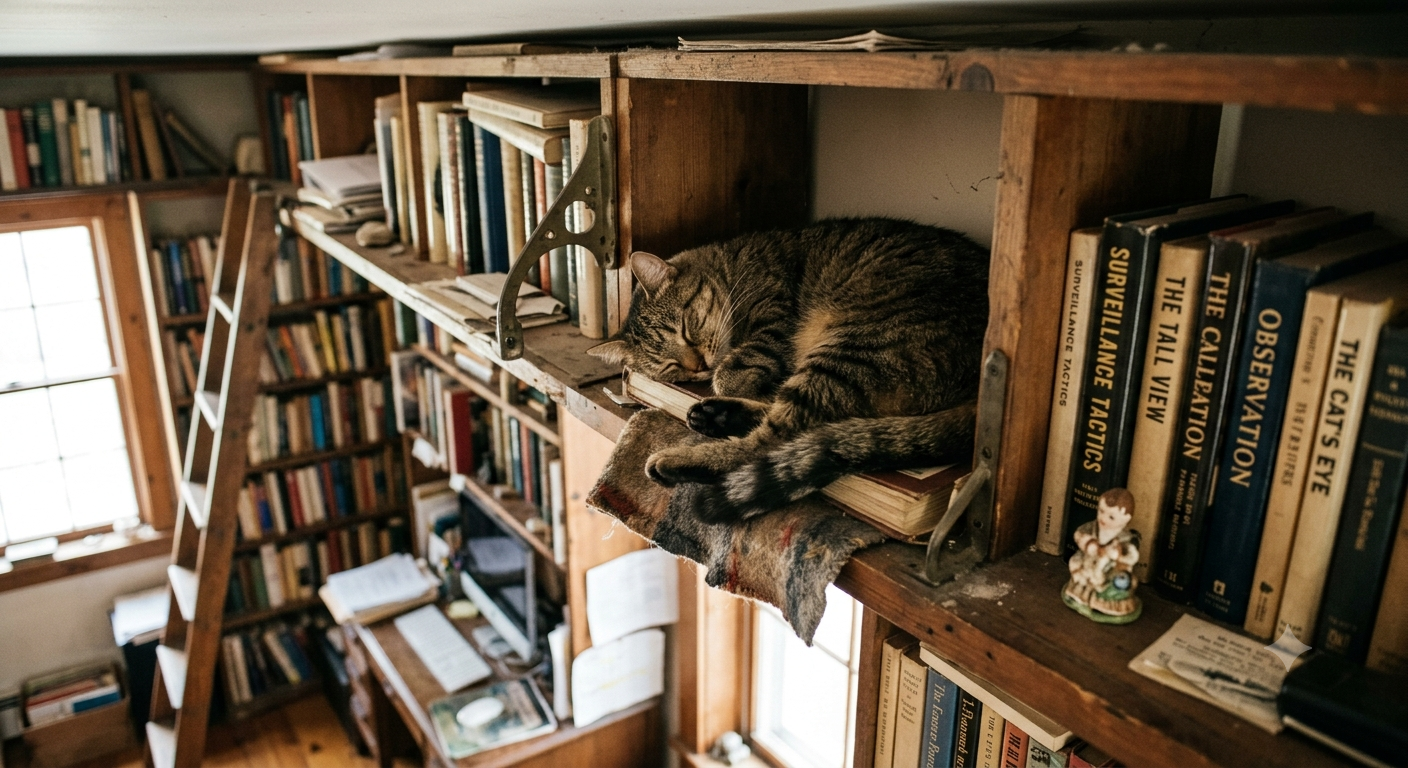
The top of the refrigerator. The highest bookshelf. The top shelf of the wardrobe that requires a full gymnastics performance to reach. The cat is up there, and from your perspective it is entirely unclear how or why.
The how has a simple answer: cats can jump six times their body length and have skeletal structures that make the ascent of most home surfaces achievable with two jumps and some brief repositioning.
The why is equally straightforward. Height is safety. Height is surveillance. Height is the position from which the full room is visible — every entrance, every exit, every other animal in the space. Cats are both predators and prey animals, so they naturally remain aware of their surroundings.
The cat on the high shelf is not doing anything wrong or inexplicable. They are sleeping in the behaviorally optimal location for their species — the elevated, enclosed position that provides maximum visibility with minimum exposure. The fact that your refrigerator is not a tree branch is a detail. The instinct does not make distinctions between natural and architectural elevation.
5. The Warm Appliance — Dryer, Radiator, Router
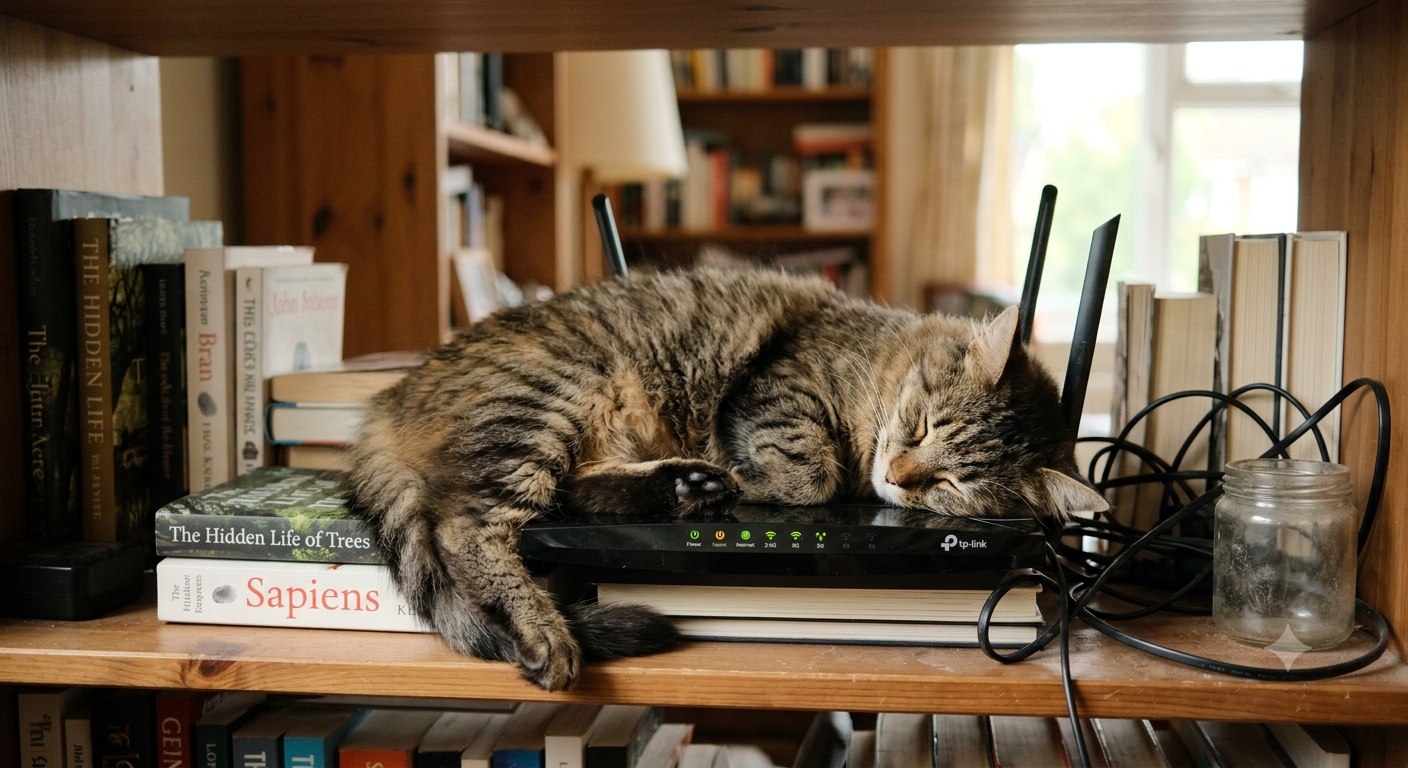
The dryer drum. The space on top of the router. The surface of the cable box. Anywhere that a heat-generating appliance creates a warm spot in the environment.
Cats have a baseline temperature of 102°F. Maintaining this temperature in a home environment at 68°F requires constant metabolic investment. Any ambient heat source that reduces that investment is metabolically valuable.
The specific warmth of the dryer drum after a cycle — exactly the right temperature for approximately two hours, then slowly cooling — is a known phenomenon among cat owners and there is nothing more to it than heat-seeking. The router’s continuous mild warmth creates a reliable low-heat surface that some cats learn to use as a permanent ambient sleeping spot.
The dryer safety warning: This bears stating directly. A cat who has learned to sleep in the dryer drum must be checked before every dryer cycle without exception. This is not alarmist — it is a documented recurring household safety issue. Keep the dryer door closed when not in use, check before every cycle, and consider a barrier if you have a persistent dryer-seeker.
6. The Bathroom — The Ritual and the Cool
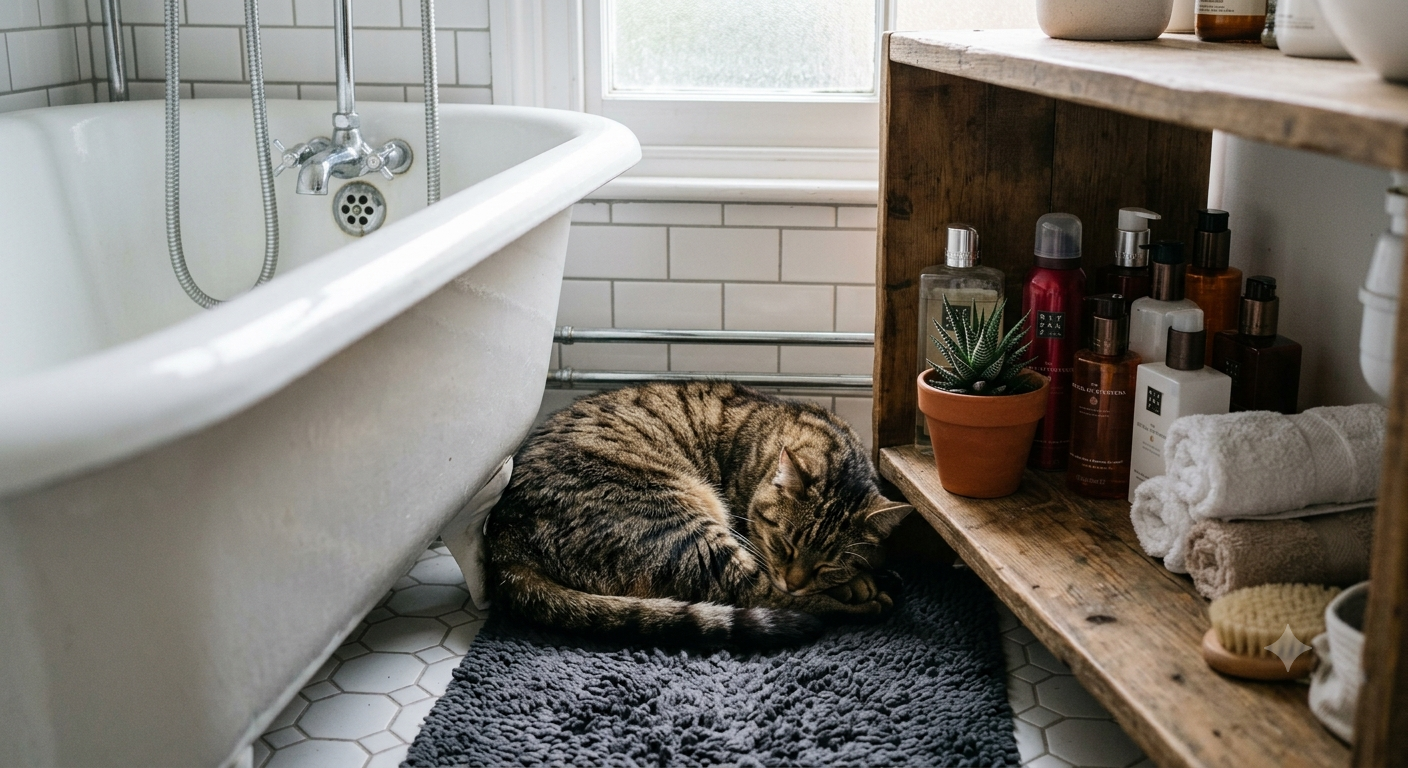
The bathroom sink, as discussed. But also the bathroom floor tile, the edge of the bathtub, the bathmat. The bathroom has a specific appeal complex that goes beyond any single factor.
The tile is cool on warm days — a surface that helps thermoregulate downward rather than providing warmth. The bathtub provides the curved wall enclosure that the sink also provides. The bathmat is soft and gripped and positioned in a room that carries your scent extremely richly — every shower deposits scent compounds, every grooming routine leaves traces.
The bathroom also tends to be one of the quieter rooms in the house during the hours the cat is not trying to access it specifically because you are there. And it has a door that closes — making it both the most inaccessible room (when you close the door) and, in the cat’s estimation, the room whose inaccessibility is the most suspicious and therefore the most requiring of investigation and occupation.
7. The Paper, the Book, the Document You Need
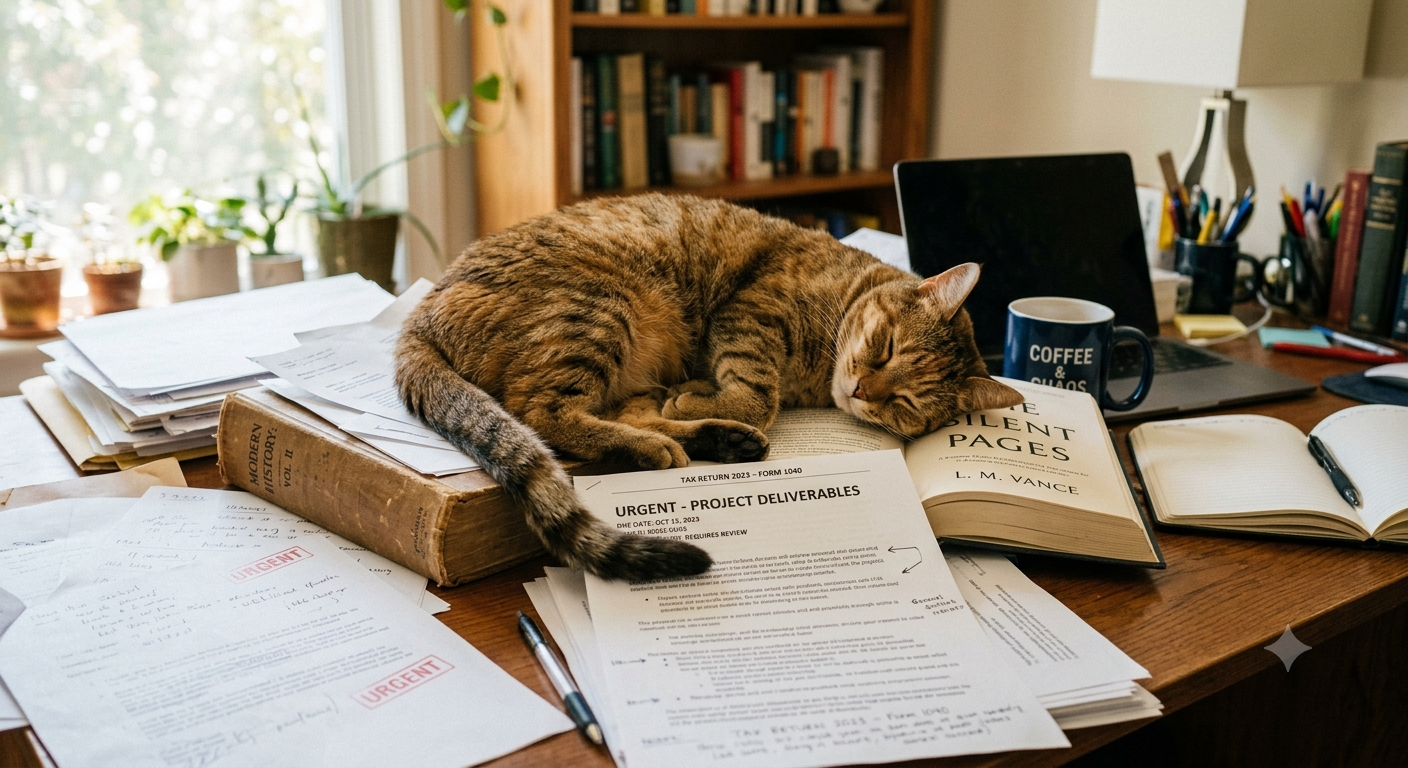
You put something flat on a surface. A newspaper, a book, a document, a piece of paper with notes on it. Within a few minutes, a cat is on it.
The warmth contribution from paper is genuinely minimal — the paper is not warmer than the surface it is on. The reason is something different and considerably more interesting.
The paper changes the tactile quality of the surface beneath the cat. Sitting on a smooth table surface requires the cat to maintain slight muscular engagement to prevent slipping. Sitting on paper provides traction — the paper grips slightly, the cat can relax their paw muscles more fully, and the resting posture is marginally more comfortable.
It is also, perhaps, proximity to whatever you are doing. The cat may have learned that paper, books, and documents involve you sitting still and paying sustained attention to a surface — and sitting on those surfaces has historically produced the kind of prolonged, focused human interaction that feels good. They are not being disruptive. They have identified that the paper leads to you and you lead to the connection they are seeking.
8. Your Suitcase — Anxiety About Departure
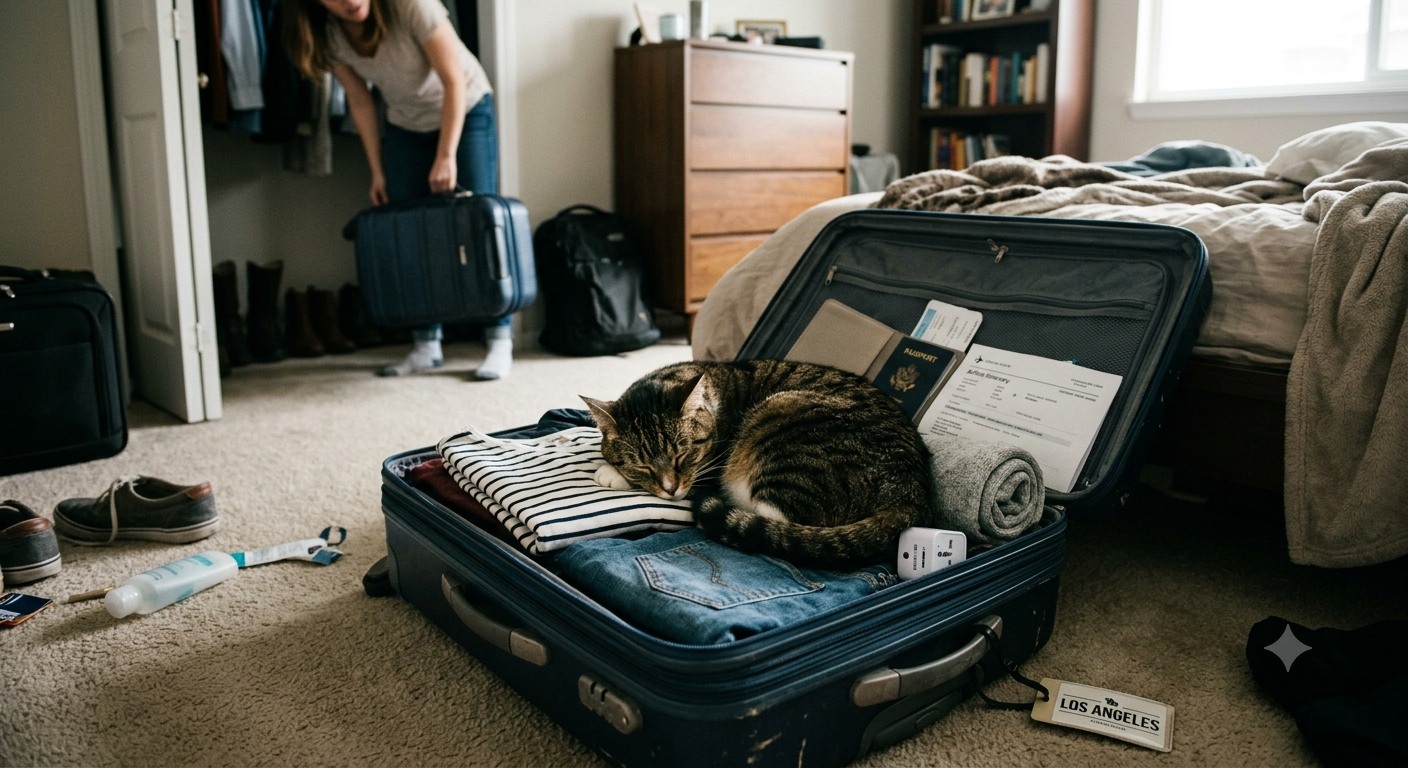
If your cat begins sleeping on or in your suitcase after you produce it from storage, you are observing one of the clearest behavioral expressions of separation concern in the feline vocabulary.
Your suitcase predicts your absence. Your cat has learned this through observation of the sequence: suitcase appears, things go into suitcase, you leave, absence follows. Sleeping on the suitcase — covering it with their scent, physically occupying it — is the cat’s behavioral response to the anxiety of the anticipated departure. They are attempting to control the situation with the only tool they have: their presence.
This is not manipulation. This is a genuinely anxious cat telling you, in the most honest way available to them, that they are worried about what comes next. The appropriate response is additional reassurance, not removal of the suitcase (which they will simply follow to its new location). Leave things that smell of you in the space where they like to sleep when you are away.
9. The Spot of Sunlight — The Perfect Science
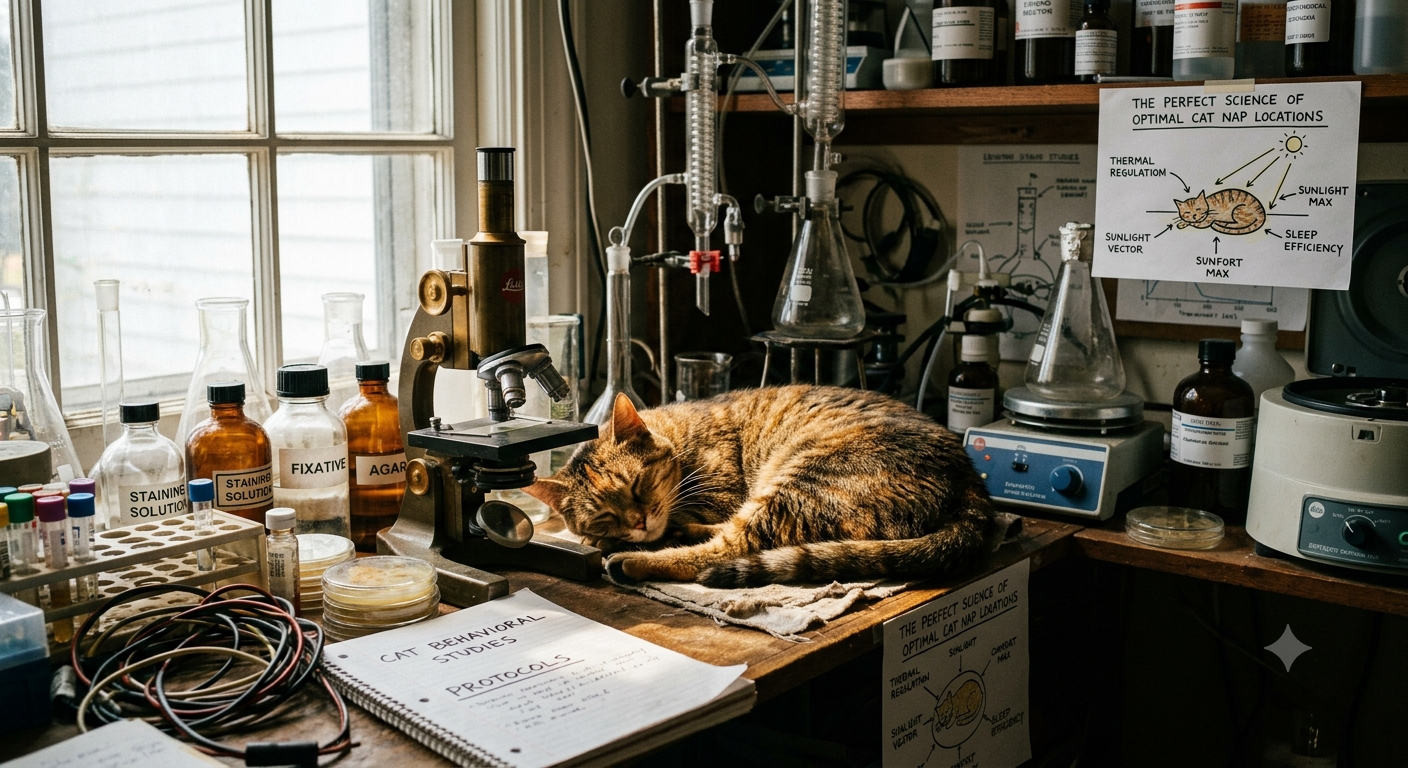
A small, moving patch of sunlight on the floor. The cat is in it. When it moves, the cat moves. This is the least mysterious choice on the list — but it deserves a moment.
Sunlight provides UV radiation that activates Vitamin D synthesis. Warmth that exceeds any artificial heat source available indoors at the same intensity. And the specific quality of natural light that stimulates the production of serotonin in ways that artificial light cannot precisely replicate.
Your cat following the sunlight patch around the room all day is engaged in one of the most sensibly pleasurable activities available to a domestic cat. The sunspot is the perfect nap location. The only flaw is its impermanence.
10. The Weird, Inexplicable One That Has No Clear Explanation
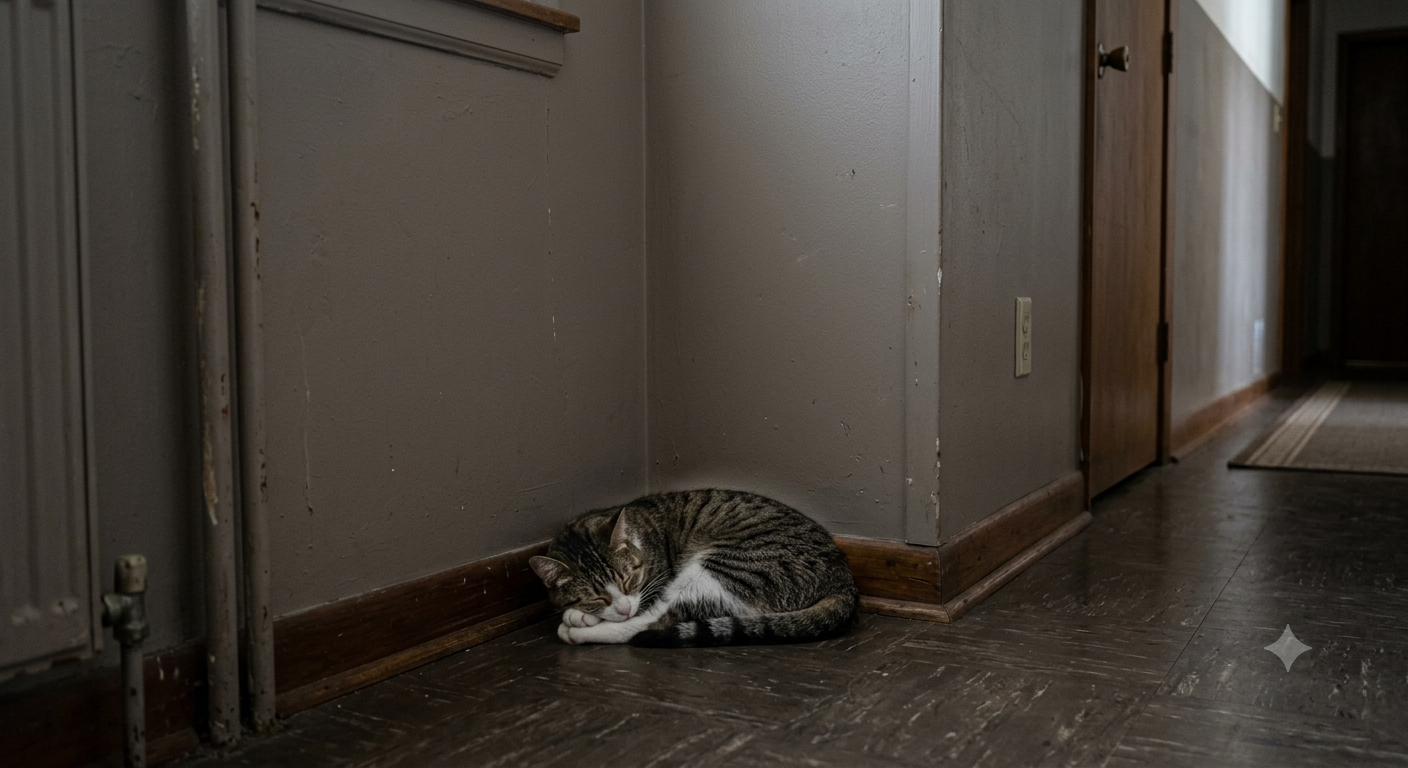
And then there is the one with no explanation. The specific corner of the hallway that catches no sun, holds no warmth, has no apparent enclosure quality, and is not near anything you value or use. The cat sleeps there consistently. You have never found a reason.
Cats have olfactory access to information that you cannot perceive. The floor of the hallway may carry scent traces from outside animals, from the building’s history, from something in the walls or under the floor that creates a specific sensory quality available only to an animal with 300 million olfactory receptors.
Or it may have been warm once, from a brief afternoon sun angle, and the cat associated it with warmth before the season changed, and the habit remained after the reason left.
Or it may be that the cat, like everyone with a rich inner life, sometimes simply wants to be somewhere specific for reasons that do not translate across species lines.
Some things do not require an explanation. They require acceptance. The cat is in the hallway corner. Leave them to it.
Every weird place your cat sleeps has a reason that makes complete sense within the behavioral framework of a small predator navigating a domestic environment with instincts built for an entirely different world. The sink is a crevice. The laptop is warmth and proximity. The suitcase is anxiety. The sunspot is perfect. The laundry is scent-marking. The high shelf is surveillance.
None of it is random. All of it is your cat, making rational decisions with the toolkit evolution gave them, in an environment that is infinitely stranger to their ancient instincts than it is to yours.
Save this to Pinterest, share it with every cat owner who has found their cat somewhere bewildering today, and appreciate the extraordinary complexity of the small creature navigating your entirely ordinary home with the sophisticated behavioral architecture of ten thousand years of cat.