
You have narrowed it down to two. Golden Retriever or Labrador Retriever. Both friendly. Both intelligent. Both family dogs. Both in the top three most popular breeds in the United States for the last three decades. Both on every “best family dog” list ever published.
And now you are reading a comparison that is supposed to help you choose between them and instead it says things like “both are great family dogs” and “the right choice depends on your lifestyle” without actually telling you anything useful about what that means in practice.
Here is the useful version.
There are ten genuinely meaningful differences between these two breeds — differences in coat management, energy expression, training dynamics, health vulnerabilities, space requirements, and the specific ways they relate to the people they live with. These ten differences are what you actually need to know before you decide.
Difference 1: The Coat — And the Commitment It Requires
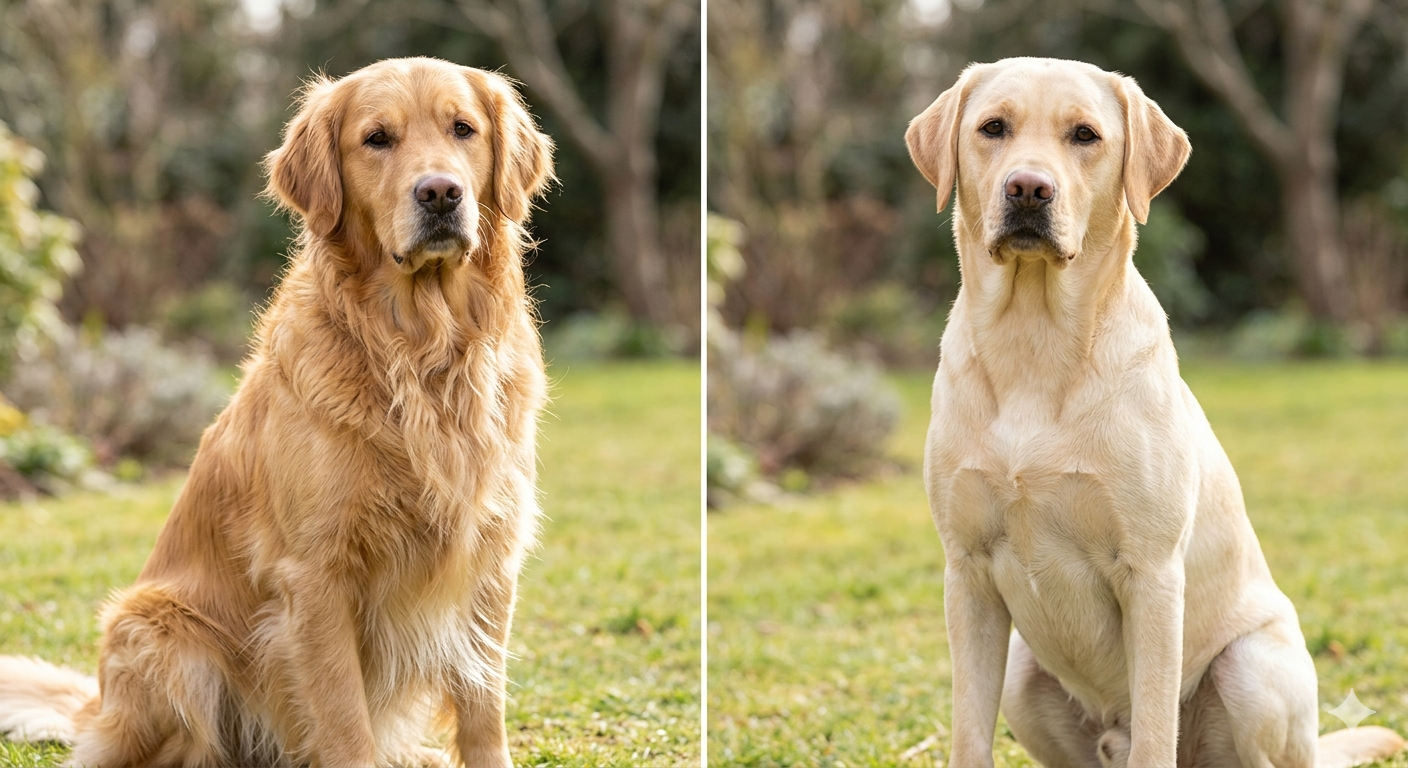
Golden Retriever: The Golden’s coat is the breed’s most immediately recognizable feature and its most labor-intensive care requirement. The double coat — dense, water-repellent outer coat and soft undercoat — flows on the neck, chest, back of the legs, and tail. It sheds continuously throughout the year and heavily during seasonal changes in spring and autumn.
Goldens need to be brushed frequently because they shed a lot. Regular grooming is required — brushing 2 to 3 times per week minimum, daily during shedding season, and professional grooming every six to eight weeks.
Labrador: The Lab’s coat is shorter, denser, and — while it still sheds — manages itself more easily between grooming sessions. Labs need occasional brushing to remove loose hair, but the commitment is meaningfully lower than for a Golden.
The verdict: If grooming is a significant time or cost consideration — or if pet hair on furniture, clothing, and food is a genuine concern — the Lab’s coat is more manageable. If the Golden’s flowing coat is part of what draws you to the breed, the grooming requirement is the cost of that beauty.
Difference 2: Energy Level and Expression
Golden Retriever: Goldens need at least 60 to 90 minutes of combined physical and mental exercise daily. Their energy is enthusiastic — they bring their full engagement to every interaction, every walk, every training session. They are also somewhat slower to mature emotionally than Labs, with many Goldens remaining notably puppy-like in their behavior well into their second and third years.
Labrador: Labs are high-energy, boisterous, and exuberant — often even more so than Goldens in the first one to two years. Labrador Retrievers require at least 60 to 90 minutes of exercise daily to keep them physically and mentally stimulated. They are also slightly faster to settle into adult behavior patterns than Goldens, though the difference is not dramatic.
The verdict: Both breeds require real daily exercise. The Lab’s energy tends to be slightly more intensely expressed in early life and slightly faster to settle. The Golden stays puppyish slightly longer — which is charming to some owners and wearing to others.
Difference 3: Training Dynamics
Golden Retriever: Goldens are highly trainable and genuinely eager to please — they respond to training with enthusiasm and make the process enjoyable. They are sensitive to tone and emotional atmosphere during training; harsh corrections or frustrated energy produce confusion and anxiety rather than correction.
Goldens were bred for cooperation, and their intelligence combines with social sensitivity to produce a dog who is genuinely invested in getting it right.
Labrador: Labs are equally intelligent and equally trainable — Labradors consistently rank in the top ten for working and obedience intelligence. Their training motivation is slightly more driven by food reward than the Golden’s (Labs are legendarily food-motivated), and their enthusiasm for training can sometimes tip into distraction from sheer excitement.
The verdict: Both are excellent training subjects. Labs may be slightly more food-motivated and slightly less emotionally sensitive to handler frustration, making them marginally more forgiving of imperfect training technique. Goldens are slightly more attuned to their handler’s emotional state, which makes positive training sessions particularly rewarding.
Difference 4: Social Needs and Attachment Style
Golden Retriever: The Golden forms intensely close bonds with their family and shows this through constant proximity — following from room to room, seeking contact during rest, monitoring their person’s location continuously. Golden Retrievers are happiest when they feel included in family activities. They do not cope well with long periods of regular isolation.
Labrador: Labs are also deeply social and bond closely with their families. They tend, on average, to tolerate periods of being alone slightly better than Goldens — though neither breed is well-suited to eight-plus hours of daily isolation.
The verdict: If your household has someone home for most of the day, either breed thrives. If the dog will regularly be alone for six-plus hours, neither is ideal — but the Lab may manage the solitude marginally better.
Difference 5: Health Vulnerabilities — Important Differences
Golden Retriever: The most serious Golden Retriever health concern is cancer — 60 to 65% of Goldens are expected to develop cancer in their lifetime, the highest rate of any breed. Hip and elbow dysplasia, heart conditions, and eye conditions are also breed concerns. Average lifespan: 10 to 12 years.
Labrador: Labs are also prone to hip and elbow dysplasia, and obesity is a significant health risk given the breed’s food motivation and potential for weight gain. Eye conditions and exercise-induced collapse (EIC) — a genetic condition causing muscle weakness after intense exercise — are Lab-specific concerns. Average lifespan: 10 to 12 years, with some lines averaging slightly longer.
The verdict: Both breeds have breed-specific health vulnerabilities worth understanding. The Golden’s cancer rate is the most statistically significant breed-specific concern. The Lab’s obesity tendency is the most preventable — with careful portion management, it is entirely avoidable. Responsible breeding with health testing is important for both.
Difference 6: Size and Space Requirements
Golden Retriever: Males 65–75 lbs, females 55–65 lbs. Built with a slightly more refined, longer structure than the Lab.
Labrador: Males 65–80 lbs, females 55–70 lbs. Built more compactly and muscularly than the Golden, the Lab is often described as more “solid” in structure at the same weight.
The verdict: Both are large dogs with comparable space requirements. The Lab’s more compact structure navigates small spaces slightly more easily; the Golden’s flowing coat makes smaller spaces feel hairier. Neither is a small apartment dog by nature — though both can adapt to apartment life with adequate daily exercise.
Difference 7: The Coat and Water
Golden Retriever: The Golden’s coat was designed for Scottish Highland conditions — water-repellent and insulating. Goldens love water and retrieve from it enthusiastically, but the long outer coat absorbs significant volume and requires thorough drying after swimming.
Labrador: The Lab’s dense, short coat is specifically designed for water retrieval — it sheds water rapidly and dries quickly. Labs are extraordinarily water-enthusiastic, and their coat is better suited to frequent water exposure than the Golden’s.
The verdict: For water-intensive activities — dock diving, regular swimming, waterfowl hunting — the Lab’s coat is more practical. For general water play and occasional swimming, both breeds are enthusiastic and capable.
Difference 8: Child and Family Compatibility
Golden Retriever: Patient nature with children, tolerance of other pets, and devotion to family members make them a perfect fit for many households. The Goldens’ emotional sensitivity makes them more likely to retreat from rough handling rather than react negatively — a quality that makes them particularly reliable with young children.
Labrador: Labs are also exceptionally family-friendly and patient with children. They are slightly more physically robust in their interaction style — a Lab playing with children tends to be more boisterous and less likely to self-regulate downward for a young child.
The verdict: Both are excellent family breeds. The Golden’s emotional sensitivity and slightly softer physical interaction style can be an advantage with very young children. The Lab’s more exuberant physical play style suits families with older, more physically capable children.
Difference 9: Purpose and Drive
Golden Retriever: Bred primarily as a hunting companion for waterfowl retrieval in the Scottish Highlands — the cooperative, sensitive partner who worked closely alongside hunters. The Goldens’ breeding for close cooperation and handler attunement is visible in their training responsiveness.
Labrador: Bred as a working dog with applications ranging from hunting and retrieving to service work, search and rescue, and drug detection. The Lab’s versatility in working roles reflects a slightly broader range of drive and a slightly higher tolerance for extended, intensive work.
The verdict: Both were bred as working gun dogs with a retrieving focus. The Lab’s slightly broader working drive makes them marginally more common in active service and working roles today. The Goldens’ cooperation and sensitivity make them equally common in therapy and emotional support roles.
Difference 10: The Intangible
This one cannot be measured, but it is real, and every person who has owned both breeds will have an opinion.
The Golden Retriever has a warmth. The specific combination of their expression, their coat, their emotional attunement, and the particular quality of their attachment to their person produces a relationship that owners consistently describe in terms that go beyond practical dog ownership. They are described as emotionally present in a way that is distinctive even among breeds with high social intelligence.
The Labrador has an uncomplicated joy. They are enthusiastic about everything — the walk, the ball, the training treat, your arrival home, the smell of something interesting at the base of the fence — with a consistency and an openness that is immediately appealing and deeply sustaining over time.
The Decision Framework
Choose the Golden Retriever if: You want a deeply emotionally attuned companion whose relationship with you is the central feature of their character. You are prepared for more extensive grooming. You prefer a dog whose training responsiveness comes from wanting to please rather than primarily from food drive.
Choose the Labrador if: You want a versatile, slightly more independently capable companion whose enthusiasm is consistently high and whose energy is direct rather than emotionally complex. You prefer lower grooming maintenance. You have a highly active lifestyle and want a dog who can match almost any physical activity.
Choose either if: You want a large, friendly, intelligent, deeply family-compatible dog whose company will enrich your daily life consistently for 10 to 12 years.
ENDING:
There is no wrong answer. The Golden Retriever and the Labrador Retriever are two of the finest companion breeds in the world, and the differences between them are of degree rather than kind. The ten points above give you the information to choose the degree that fits your life.
Save this comparison to Pinterest, share it with anyone who is still deciding, and know that whichever dog comes home will be the right dog — because both of them are excellent at becoming the right dog for the person who chose them.