Physical exercise gets all the credit, but mental stimulation is just as important for your dog’s wellbeing — and it’s often the missing piece when dogs are destructive, anxious, or seem impossible to tire out.
A dog that gets 30 minutes of real mental work can be calmer and more satisfied than one that gets an hour of physical exercise with zero brain engagement. Here’s what that actually looks like in practice.
Why Mental Stimulation Matters More Than Most Owners Realize
Dogs were bred to work. Even breeds we now consider purely companion animals were originally developed with a job — herding, hunting, guarding, or retrieving. When a dog lives indoors with nothing to solve, nothing to track, nothing to figure out, that job energy has to go somewhere.
It usually goes somewhere you don’t want it to go: into your furniture, your shoes, your garden, or into repetitive behaviors like excessive barking, pacing, or digging.
The good news is that mental enrichment doesn’t require expensive equipment or hours of your time. Most of the ideas below take five to fifteen minutes and use things you already have at home.
Signs Your Dog Needs More Mental Stimulation
- Destructive chewing, especially of household objects
- Excessive barking or whining without a clear trigger
- Restlessness after exercise — can’t seem to settle
- Following you obsessively from room to room
- Repetitive behaviors like spinning, tail-chasing, or pacing
- Getting into the trash or counter-surfing repeatedly
If several of these ring a bell, the following ideas are your starting point.
12 Terrible Dog Training Mistakes Owners Make →
1. Use a Puzzle Feeder Instead of a Bowl
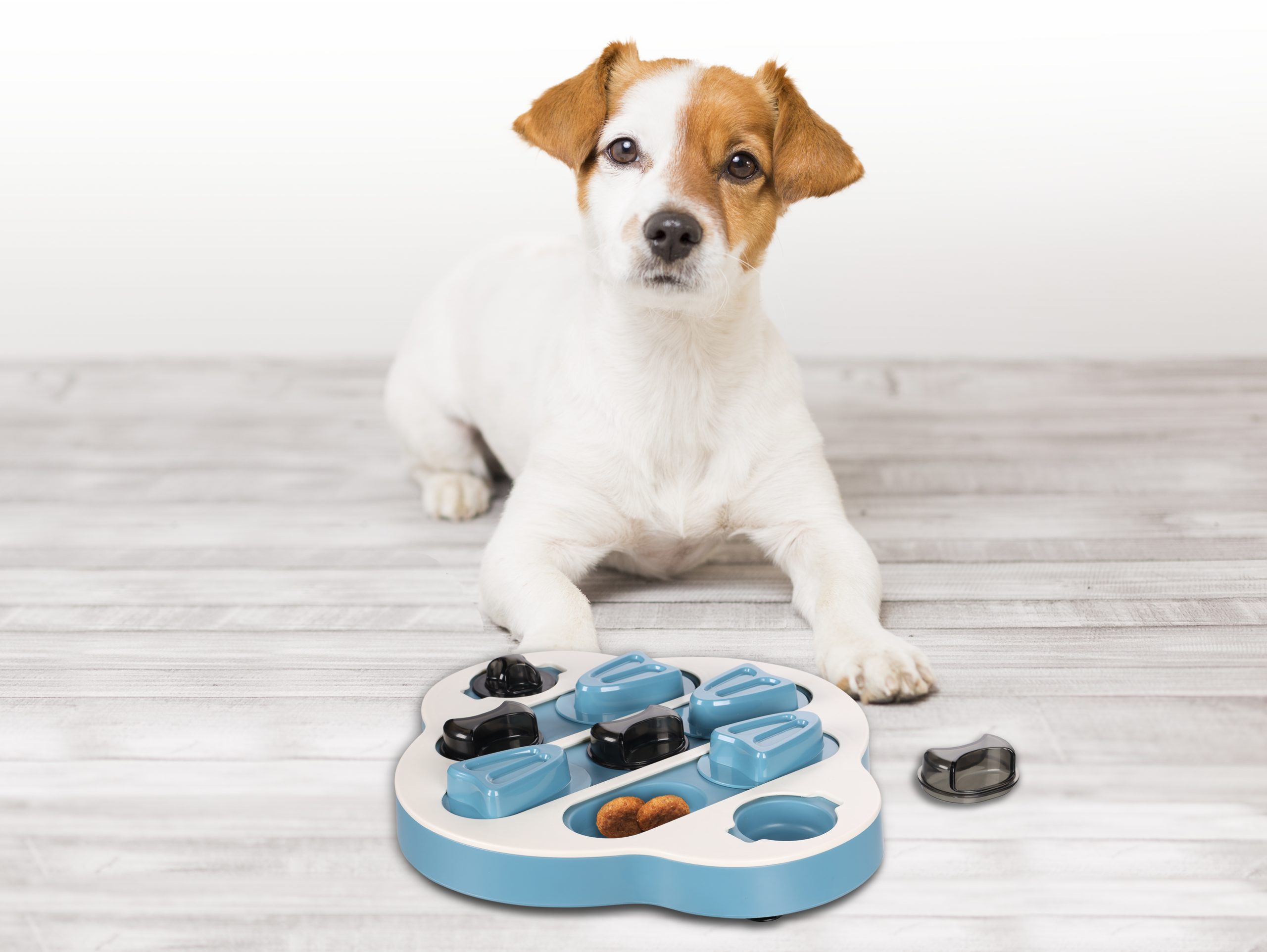
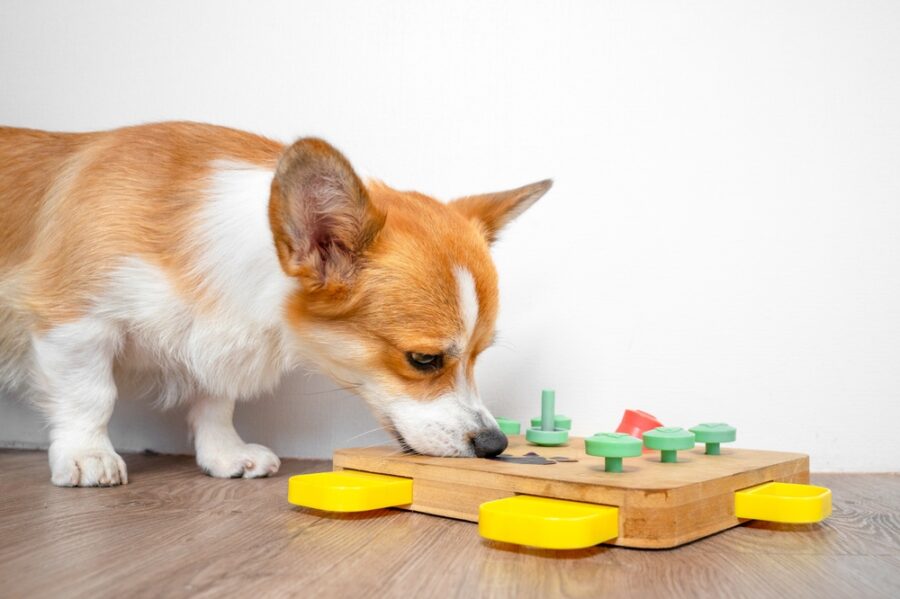
This is the single highest-impact change most dog owners can make with minimal effort. Instead of placing your dog’s kibble in a bowl, put it in a puzzle feeder — a device that requires your dog to slide, lift, or spin pieces to access the food.
The meal itself becomes a twenty-minute problem-solving session. Dogs using puzzle feeders eat more slowly, work harder for their food (which is psychologically satisfying for them), and settle more calmly afterward.
Start with a Level 1 puzzle if your dog has never used one. Going straight to a hard puzzle leads to frustration, not enrichment.
2. Hide Food Around the House (Scatter Feeding)
Before giving your dog their meal, scatter it around a room — on the floor, hidden under a mat, tucked between couch cushions. Then let your dog find it using their nose.
Sniffing is one of the most mentally tiring activities for a dog. It engages their brain at a deep, focused level. A ten-minute sniff hunt can have the same calming effect as a much longer walk.
3. Teach a New Command Every Week
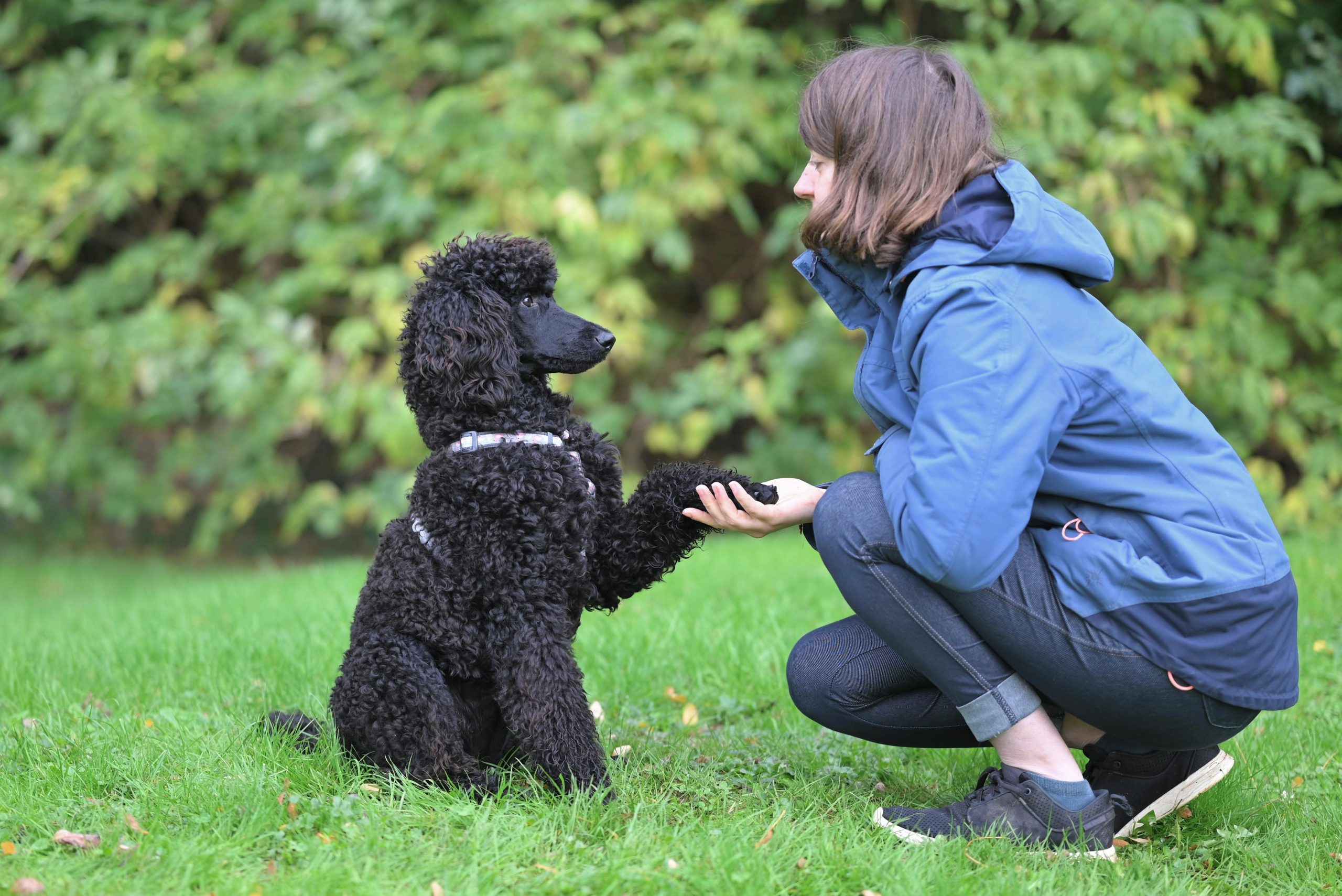
Training isn’t just about obedience — it’s active mental engagement. Learning a new behavior requires your dog to pay attention, try different responses, and figure out what earns the reward. That process is genuinely tiring in the best way.
Keep sessions short — dogs learn better in multiple short bursts than in one long session — and end on a success every time.
4. Snuffle Mats: Nose Work in a Compact Format
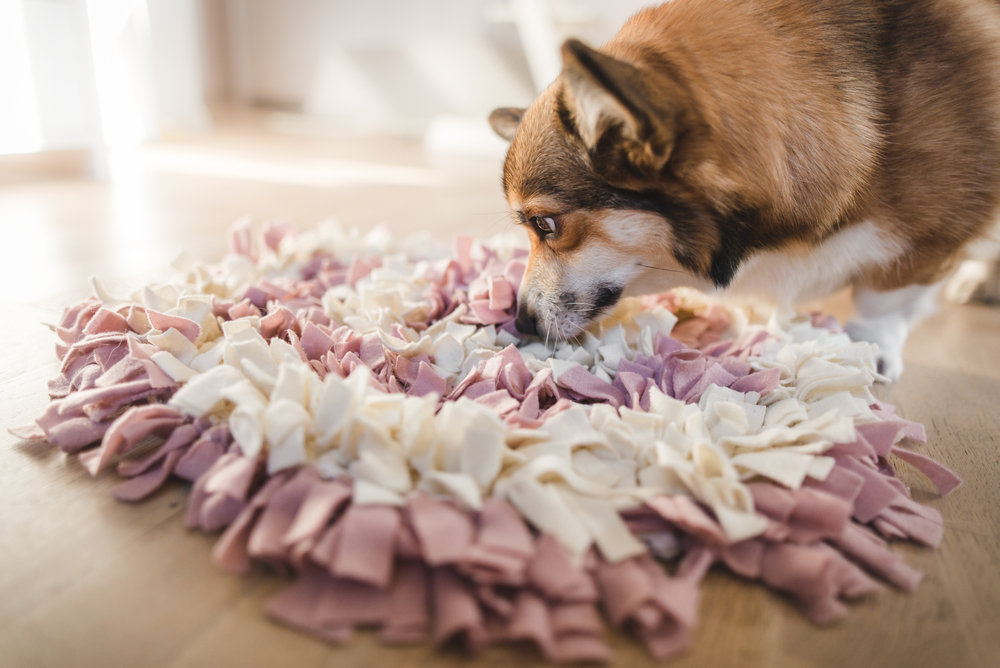
A snuffle mat is a rubber mat with strips of fleece woven through it. You press kibble or treats into the fleece, and your dog has to use their nose to find them.
It’s simpler than a puzzle feeder and great for dogs who are new to enrichment, dogs with limited mobility, or for a quick mid-day brain break. Most snuffle mats take a few minutes to load and give your dog fifteen to twenty minutes of focused sniffing.
5. The “Which Hand” Game
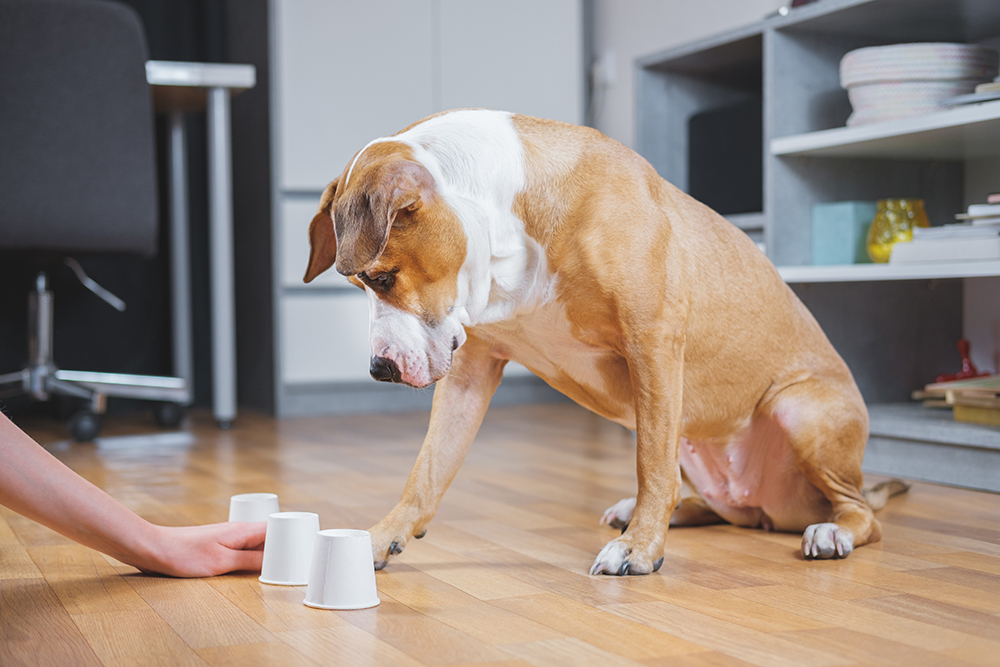
Close a treat in one of your fists. Hold both fists out in front of your dog. Ask them to “find it” and wait. When they touch or sniff the correct hand, open it and reward them.
This sounds simple, but it requires concentration, impulse control, and decision-making. Build up to harder versions: use cups, hide treats under objects, or use multiple decoy containers.
6. Kong or Lick Mat Stuffing
A stuffed Kong or lick mat gives a dog extended, low-stress mental engagement. Fill a Kong with a combination of foods — kibble, a smear of xylitol-free peanut butter, banana, plain Greek yogurt — and freeze it overnight.
The frozen version lasts significantly longer. Lick mats work similarly — the repetitive licking motion has a calming effect linked to serotonin release, which is why vets sometimes recommend them for anxious dogs.
7. New Smells: The Enrichment That Costs Nothing
Exposing your dog to new smells is genuinely stimulating. Bring home a stick or leaf from a walk and let your dog investigate it. Rub a towel on a friend’s dog and let your dog smell it. Place a small amount of a novel herb (rosemary, basil) on a mat for investigation.
Your dog’s nose has 300 million scent receptors compared to a human’s 6 million. The olfactory world they inhabit is incomprehensibly rich, and letting them engage with new smells gives their primary sense a real workout.
8. Rotation: Make Old Toys New Again
Dogs habituate to their toys quickly. Toy rotation solves this without buying anything new.
Divide your dog’s toys into three or four groups. Put out one group for a week, then swap it for a different group. When toys come back out after a period of absence, dogs engage with them almost like they’re new.
9. Interactive Play That Makes Your Dog Think
Fetch is a physical exercise. Tug is a physical exercise. But interactive play that has rules — play that requires your dog to make decisions and follow cues — is also mental exercise.
Try “stop” games where you pause a play session and ask for a known command before continuing. The interruptions and variations require your dog to pay attention and adapt, which is mentally engaging.
10. DIY Enrichment Boxes

Take a cardboard box and fill it with crumpled paper, old fabric pieces, or toilet paper tubes — with treats hidden throughout. Let your dog dig through it and find the food.
This engages natural foraging behavior, satisfies the urge to dig, and gives your dog something they’re allowed to destroy. It takes about ninety seconds to set up and will occupy a dog for far longer than you’d expect.
How Much Mental Stimulation Does a Dog Need?
A general baseline is 15 to 30 minutes of dedicated mental enrichment per day for most adult dogs, on top of physical exercise. High-drive working breeds (Border Collies, Belgian Malinois, German Shepherds) may need more. Senior dogs and puppies benefit from shorter, more frequent sessions.
Watch your dog’s behavior as the indicator. A dog getting enough mental engagement tends to be calmer, more relaxed after activities, and less likely to exhibit destructive or attention-seeking behaviors.